Home burglary rates in Czech Republic have declined steadily since 2015, according to data from the Czech Police Presidium (Policejní prezidium ČR). Despite this trend, interest in home security devices has grown — partly because the technology has become affordable, partly because smart security now integrates with the broader home automation stack. This article focuses on what the hardware actually does in the conditions of typical Czech residential buildings.
Czech Building Constraints
Two building types dominate Czech residential stock and create different security challenges:
Panelák (panel apartment blocks) — prefabricated concrete buildings from the 1960s–1980s. Thick concrete floors and walls limit wireless signal penetration. Door frames are metal, which can interfere with magnetic door sensors if not positioned correctly. Common areas (hallways, stairwells) are shared and cannot be secured by individual tenants.
Cihla (brick buildings) — older brick construction, common in Prague's inner districts and Brno. Better signal penetration but often original wooden window frames that are easier to breach than PVC equivalents. Interior walls are thinner, so door and window sensor placement matters more.
Wi-Fi Cameras: Indoor and Outdoor Options
The Xiaomi Mi 360° Home Security Camera 2K is the most commonly sold indoor camera in Czech e-shops, available at Alza and GearBest-affiliated stores for 700–950 CZK. It connects to 2.4 GHz Wi-Fi and streams at 2304×1296 resolution. Motion detection triggers push notifications and local recording to a microSD card (not included). Cloud storage is available but requires a Mi Home account.
For outdoor use, the TP-Link Tapo C310 (1 200–1 400 CZK) has an IP66 rating, which handles Czech rain and temperature ranges from −25°C to 65°C. The Tapo app functions without a mandatory cloud subscription — local RTSP streaming is available, making it compatible with Home Assistant and local NVR software.
Reolink cameras (RLC-810A, approximately 2 200 CZK) offer 4K resolution and PoE (Power over Ethernet) connectivity. PoE eliminates battery concerns and Wi-Fi dependency for fixed outdoor positions — relevant for Czech house owners who can run ethernet along the exterior. Reolink's local NVR integration means footage never leaves the premises unless explicitly configured to do so.
Door and Window Sensors
Magnetic reed sensors detect whether a door or window is open. The simplest versions (Sonoff SNZB-04, approximately 180 CZK each) use Zigbee and pair with a Zigbee hub. They are small (roughly the size of a matchbox), require only adhesive mounting, and cause no structural modification to the door frame — relevant for rental properties.
The Aqara Door and Window Sensor (299–350 CZK) is also Zigbee-based and notable for its logged event history, accessible via the Aqara app without cloud subscription in newer firmware. In a Czech panel apartment with a metal door frame, sensor placement at the hinge side rather than the lock side typically gives more reliable magnetic contact.
Alarm Panels and Sirens
Standalone alarm systems — those that function without internet connectivity — remain the most reliable category. The DSC PC1616 and Jablotron JA-101K are professional-grade panels frequently specified by Czech security installers. Both support wired zone inputs, meaning sensors connect via cable rather than radio — no battery dependency, no interference from thick concrete walls.
For DIY users, the Ajax Systems alarm hub (Hub 2, approximately 7 000–8 500 CZK for the base unit) uses a proprietary 868 MHz radio protocol with two-way communication and encrypted transmission. Czech distributor: AJAX Systems CZ. The system includes tamper protection — attempting to open the hub triggers an alert. A cellular SIM backup means alerts continue even if the home broadband is cut.

Schematic view of home automation sensor integration — the same principle applies to security sensor wiring
Motion Sensors
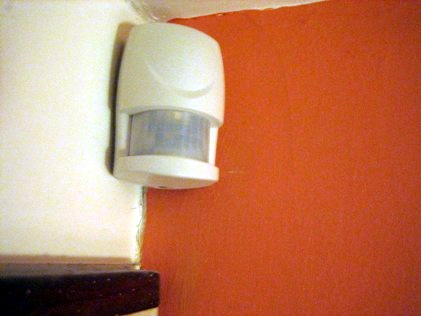
Passive infrared (PIR) motion sensors are the standard indoor motion detection technology. The Philips Hue Motion Sensor (899–1 050 CZK) integrates tightly with the Hue lighting ecosystem — triggering lights or scenes when motion is detected. It also has a lux sensor, so it only activates in darkness if configured. Battery life is approximately two years on a CR2450 cell.
For security-focused use rather than lighting automation, the Ajax MotionCam (2 200–2 500 CZK) adds a camera to the PIR: when motion is detected, it captures a short burst of images rather than continuous video, significantly reducing false alert bandwidth while still providing visual confirmation of the event.
Device Comparison
| Device Type | Example Model | Protocol | Cloud Required | Price (CZK) |
|---|---|---|---|---|
| Indoor camera | Xiaomi Mi 360° 2K | Wi-Fi | Optional | 700–950 |
| Outdoor camera | TP-Link Tapo C310 | Wi-Fi | No (RTSP) | 1 200–1 400 |
| Door sensor | Aqara Door Sensor | Zigbee | Optional | 299–350 |
| Alarm hub | Ajax Hub 2 | 868 MHz + Ethernet | Optional | 7 000–8 500 |
| Motion sensor | Ajax MotionCam | Ajax Radio | Optional | 2 200–2 500 |
| Siren | Ajax HomeSiren | Ajax Radio | No | 1 400–1 700 |
Legal Notes Specific to Czech Republic
- Home security alarm systems do not require registration in Czech Republic unless they are connected to a licensed response centre (PCO — Pult centrální ochrany)
- If connecting to a PCO, the monitoring company must be licensed by the Czech Trade Licensing Office
- False alarms can result in police charges under zákon č. 273/2008 Sb. — tamper-proof sensors and pet immunity settings reduce this risk
- Data from cameras stored longer than 72 hours may require a data processing register entry under Czech GDPR implementation if more than 10 people are regularly recorded
- More information: Policie ČR — Úřad pro ochranu osobních údajů (UOOU)
Practical Setup Sequence
- Identify your primary risk vector — door entry, window entry, or internal movement detection
- Check whether your building allows exterior camera mounting (house rules in apartment buildings vary)
- Choose a protocol that matches your existing smart home hub if any — Zigbee sensors integrate with Philips Hue, IKEA, or Home Assistant; Ajax is self-contained
- Install and test each sensor individually before configuring automations
- Set up notifications with a second device as backup — a tablet left at home can act as a secondary alert point
- Keep firmware updated; most security vulnerabilities in consumer cameras exploit outdated firmware

